Leaving Normal: Link Ray
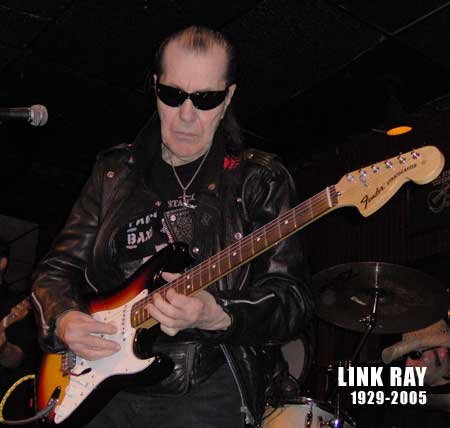
Influential rock’n’roll pioneer with a raw, primal sound
Unable to get the distorted sound that he wanted, Link punched holes in his amp speakers with a pencil. Although the song sold four million copies and an LP’s worth of material was cut, Link and his Wraymen, as they were now calling themselves, were promptly dropped from the label because Bleyer felt their music was a bad influence on teenagers.
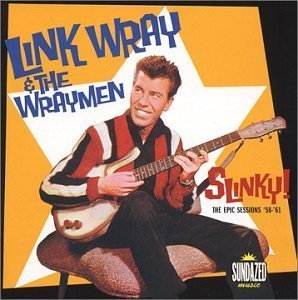 One could hardly argue with him. Link and the Wraymen attacked their instruments with a savagery that was heretofore unprecedented, mangling the strings and fret boards of their instruments almost beyond recognition on wax and in person at rough ‘n’ tumble D.C. clubs like Benny’s Rebel Room, the Rocket Room and the notorious 1023 Club. Whether the rough surroundings and rowdy crowds had anything to do with it or not, Link’s music was laced with an undeniable, underlying mood of menace. Raunchy instrumentals like “Ace Of Spades,” “Rawhide,” “Comanche,” “Jack The Ripper” and “Big City After Dark” certainly sounded like the soundtracks to gang fights and late night playground showdowns, whether they were intended to or not. Then there were the occasional vocal numbers, like Jimmy Reed’s “Ain’t That Lovin’ You Baby,” Ray Charles’ “Mary Ann” and Willie Dixon’s “Hidden Charms.” Link hollered them in a voice so insanely deranged that it can only be described as the vocal equivalent of his guitar style. And, lest we forget, Link played sideman to his buddy Bunker Hill on Bunker’s insane “The Girl Can’t Dance.” Brilliant minds do think alike.
Nowadays, he’s known as the godfather of surf, garage, glam rock, punk, heavy metal and grunge, but Link doesn’t need any of these accolades, for he’s always been the sickest guitar player—and vocalist—in all of rock ‘n’ roll. Amen! – from knights-maumau.com
Official Site
DOWNLOAD 5 tunes (including Rumble, Law of the Jungle & also covers by recent garage-punkers; Mystery Action, Hellbenders & The Milkshakes:
three mp3s by the man here:
three more here:
======================================
from:
The Guardian UK
Garth Cartwright
Tuesday November 22, 2005
The Guardian
Link Wray, the original master blaster of rock’n’roll guitar, has died at his home in Copenhagen, aged 76. He enjoyed little mainstream success but his primal music guaranteed him a cult following that kept him working right up to this year. Indeed, the last 15 years found him enjoying a higher profile than at any time since his initial hits, with such films as Pulp Fiction and Independence Day employing his music.
Wray’s talent was a limited one, but in his ability to employ distortion and push the electric guitar to places that it had never been before, he was a 20th-century innovator. His best recordings retain their original menace and raw power, and his influence on rock music cannot be overestimated: the Who’s Pete Townshend acknowledged, “He is the king; if it hadn’t been for Link Wray and Rumble, I would have never picked up a guitar.”
Wray was born in Dunn, North Carolina, to semi-literate Shawnee Native American parents. His father suffered from shell shock as a result of his experience in the first world war. The family lived an itinerant life, often sleeping rough, earning a meagre living from farm work and street preaching. “Elvis, he grew up white-man poor; I was growing up Shawnee poor,” Wray told an interviewer. He recalled that his family lived in fear of the Ku Klux Klan.
Wray started playing the guitar as a child. While serving in the Korean war, he contacted tuberculosis and had a lung removed. With his brothers, Vernon and Doug, he recorded country songs as the Palomino Ranch Hands in 1955. Changing their name to the Ray-Men, they jumped aboard the rock’n’roll juggernaut then under way.
Wray claimed that his lack of musical ability forced him to invent sounds. He effectively did this by punching holes in his amplifier and running a major chord up and down the fret board, thus creating the thundering sound known as the power chord. “I was looking for something Chet Atkins wasn’t doing, that all the jazz kings wasn’t doing. I was looking for my own sound,” he said.
In 1958, Cadence, a small record company in Washington DC, approved a primitive instrumental recorded by Wray. The label’s owner, Archie Bleyer, declined to issue it, until he found his teenage daughter expressing enthusiasm for the work, and saying that it reminded her of the rumble scenes in West Side Story. Bleyer named the instrumental Rumble, and duly released it. The record became a controversial US hit – several radio stations banned it for fear of inciting teenage violence.
Bleyer panicked and told Wray he had to clean up his act. Instead, he signed with Epic Records, where he scored with the instrumental Rawhide. Epic also tried to clean up Wray, forcing him to record standards when his appeal was about creating the crudest sounding music ever recorded.
Wray and his brothers left Epic and briefly formed Rumble Records, issuing three singles, including an instrumental called Jack the Ripper, which was picked up by Philadelphia’s Swan Records and gave Wray his final US hit. The years at Swan found Wray at his most productive, as the label allowed him the freedom to record his instrumentals unhindered by executive decisions. He turned the family chicken coop into a crude recording studio and produced wild, experimental guitar instrumentals, while continuing to play in many of America’s grimmest bars and clubs. But the British invasion by the likes of the Beatles rendered Wray obsolete. The fact that John Lennon and other British guitarists loved his work was an irony that passed him by.
Wray’s fortunes waxed and waned throughout the 1970s. Many celebrated rock musicians championed him as an unsung pioneer. He was brought to England to record for Virgin Records, then produced two high-profile albums with retro-rockabilly singer Robert Gordon. If he never enjoyed mainstream success, at least his talent was acknowledged and Europe gave him a new audience.
In 1979, Wray married Olive Julie Povlsen, a Danish student of Native American culture; the following year, they settled in Copenhagen. Povlsen began managing Wray in 1981. The 1980s rockabilly revival raised his profile, while the inclusion of Jack the Ripper in Richard Gere’s 1983 film, Breathless, proved how cinematic his music was. He is survived by his wife and son.
¬? Frederick Lincoln Wray Jr, musician, born May 2 1929; died November 5 2005




Where would punk rock be without this guy? In fact, Lemmy would NOT even exist!!! The Cramps would be accountants!! and you guys maybe in a BORIA somewhere! And me? I’ll be called as Joe Baju Merah, the not-so-bad Dikir Karut rapper in the east coast. Dear gawd, thank you.
guess without him..there won’t be rockabiily punk as well…yeah The Cramps!!! Social Distortions.Thanx for the info Joe!!!
almost like surf music la Joe…surf dtg dulu ke dia dulu?
boleh suggest band2 classic rockabilly utk di download?
YEA I GREW UP LISTENING TO THE SOUNDS THAT MAKE YOU FALL DOWN OF THE POWERCHORD MASTER LINK WRAY AND THE WRAYMEN OR RAYMEN .WE USE TO GO TO PLACES LIKE THE ROCKET ROOM ,HAYLOFT, BENNY’S REBELROOM VINNIE’S THE, UNDERGROUND AND CLUBS OF THAT NATURE .THOSE WERE THE ONLY PLACES WHERE YOU COULD SEE AND HEAR WILD FREE-FORM ROCK AN ROLL. WE WERE FROM THE LAUREL, MD. AREA. THE MORE WE HEARD HIS MUSIC THE MORE WE THIRSTED FOR IT. IT JUST MADE YOU WANT TO GET UP AN DANCE JUMP, BOP AN ROCK AND ROLL. I REMEMBER HAVING A REALLY GOOD EXPERIENCE ABOUT LIFE, GROWING UP WITH THE MUSIC EXPLOSION JUST BEING THERE, WALKING STREETS (14th, K st. M st.) GOING FROM CLUB TO CLUB, BEING IN THE SCENE. THERE WAS NOTHING LIKE IT !!!! NOWADAYS IT’S CHANGED, YOU NEED SHIRT AN TIE (THERE NO FREE FLAVOR IN THE AIR) EVERYBODY AFRAID OF ZERO TOLERANCE. THEY THINK SOMETHING DIFFERENT IS UNACCEPTABLE SCARED OF THEIR OWN SHADOWS. NOT ME. CHRIS SCOBIE BAND AKA LINK WRAY BE WILD NOT EVIL…………..
YOU WANT TO HEAR MORE GO TO YOU TUBE AND LISTEN TO OUR ROCK AN ROLL LINK WRAY COVERBAND. SCOBIE
Thanks for sharing, Chris! Those must be crazy, crazy days!