
Cher Tan: 97-Shiki Interview
ricenotes: an interview by Cher Tan of Two Seconds Notice zine in Singapore, brought here via Kid Kah-Roe-Shi. Will have more pictures to break up the “wordiness” soon, too busy boss!
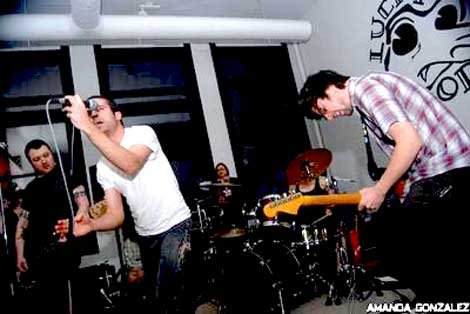
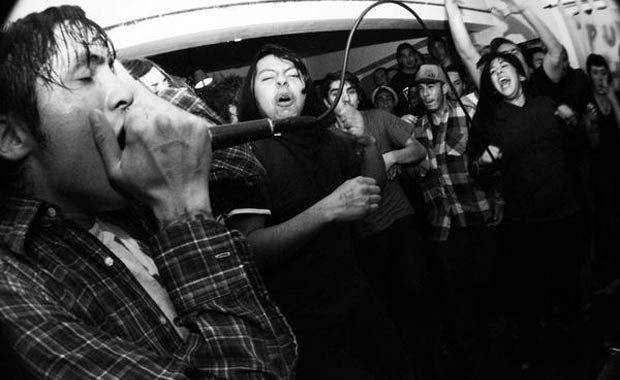
The people in 97-SHIKI have been playing together for years, but have only got together as 97-SHIKI the collective entity just this past spring. Playing a sort of discordant, yet seamless punk not easily pigeonholed into your hundred and one sub-genres (they don’t want you to!), they hope to bring their past musical experiences together to birth a monster of a new kind, resulting in a brilliant cacophony one might even describe as “beautiful fucking noise”, as they so very much proclaim to be.
97-SHIKI are Patrick Scott – guitar; Ryan Durkin – vocals; Kammy Lee – drums; and Douglas Ward – bass and vocals.
What in the world is “97-SHIKI”? Can you please explain?
Douglas: It is an odd name. “Shiki” is a Japanese word for “type” or “system” or “series” or “model”, so 97-SHIKI means sort of “System-97” or “Number-97”. It doesn’t really mean anything other than we like it because it doesn’t sound like any other band name, and it is interesting.
In your own words, how would you describe the style of music you play? What spurred you to play this particular style?
Douglas: Maybe it’s easier to describe what we’re trying to do, musically, instead. When we got together to form the band, none of us was saying “let’s do a band that sounds like… hardcore/noise/grunge/crustcore/hip-hop…” or whatever. Also, we knew that none of us wanted to “pick a musical genre” and stay inside those lines. We all share a drive to make loud, weird, sharp, angry, smart music, and that’s what is coming out so far. I guess to toss labels you can say things like post-hardcore, noise rock, screamo-y post-punk -ish stuff.
But it is a real mix of all our past bands’ sounds. Personally, I am tired of bands who think punk is a sound, pick their favorite “style” and emulate it. Punk was born out of NOT copying the stuff that came before, not trying to fit in, and about being original and taking chances. I love old punk, and I’ve been doing various sounding bands for over 25 years, but I don’t want to either copy anything or repeat things I’ve done before.
Change and taking chances is what I think all of are interested in doing, and so that, if anything, is what our style is.
For how long has 97-SHIKI been playing? How did the band get together in the first place? Was it more of a “part-time” thing before, which evolved into a more committed thing now?
Douglas: We started practicing together at the end of 2007, and started playing out in the spring of 2008. Kammy and I played together in FOURTH ROTOR from 2000-2006, and Patrick and I played in V. REVERSE from 1995-1997. But we’ve all played shows with each other’s bands for years. We all knew and respected each other talents, and we all knew we’d come up with something interesting.
And everyone shared a desire to do DIY shows, and lot’s of touring all over the world, if possible. We actually didn’t even know, other than our drummer Kammy, what instruments we were going to play. Ryan, Patrick, and myself have all been “lead” singers before, Ryan played bass in another band once, and I’ve played guitar in all my other bands before this.
But we figured it out, and now I play bass, and do backup vocals, Ryan sings, Patrick does guitar, and Kammy drums. The bottom line was the the people, more than the exact instruments or “style” were the most important, and the rest fell into place after we decided to do this together.
Are there any releases, and if not, are there any plans for such?
Douglas: We’re recording in a few days for our first release, which will be a 7″/digital download.
Patrick: We live in an incredibly interesting time in the regard of music format. In the US many people have mp3 players and at least some easy access to computers. The major labels are freaking out because resourceful kids and students have figured out how to completely subvert the way music is sold. This is kind of liberating, as it means that now, we get to set up our own rules and can take more control of how we make our music/art available to people and what the final medium is. For example, the label that I am a part of (who is releasing the 97-SHIKI 7″) has made the decision to stop doing CDs and focus mainly on vinyl and digital downloads, including a download with the vinyl so people who have mp3 players and turntables don’t have to buy the record twice.
Further, I’ve been thinking and am starting a “sister”-label which will have every effort made to be environmentally sustainable. The idea is to not use any plastic and no less than 70% recycled paper. The releases will be made available as a “card” that has artwork and a download code printed on it. This is contained in a CD sized jacket with artwork and notes/lyrics etc. the person would download the music in whatever file form the artist chooses (i. e. a video, mp3, or more high resolution file like. aiff, etc. Granted, access to computers is a major component to this idea, but the label will be focused mostly on experimental electronic music where most of the listeners are using computers anyway. If it works out, I’ll most likely start releasing recordings in this format on my more “rock” music based label.
Most of you are obviously gaining in age. What’s it like playing music associated with youth? Are you still excited about music?
Kammy: When I was younger I did actually think that when I got older I’d have to stop being involved in music and punk/underground culture, and start doing “older people stuff”, whatever that was. Well obviously that hasn’t happened. Music is part of who I am. As for age, age is just a number.
Patrick: I realized rather early on that punk wasn’t the music, it IS the idea, the motivation, the inspiration, the ethic, the community. It is a wonderful thing to be in environments where people are as passionate about their beliefs and feelings as you are, that’s what drew me into this world when i was younger, and it’s why i continue to participate.
Douglas: We all are passionate about music and that’s how we express our views of the world, ourselves, life, politics, people, etc. But it’s not just music, it’d the DiY scene, the people, the underground/counterculture that I need to keep involved in, help grow, and watch evolve. This sort of thing starts for most people when they’re still kids or very young, and a lot of people fade out of it as they get older. I don’t see any reason why age has to be a reason to stop. If anything, I personally more confident in doing this, more inspired, and more focused.
You have plans to tour Southeast Asia at the end of the year. Have you toured elsewhere prior to this? What have they been like?
Douglas: This will be our first tour, as we’re very new. It is weird to us, and all our friends, that our first tour is one of the most far away tours possible — we haven’t even toured the U. S.. But when the chance came up, through Ryan’s friendship with Arwith of Utarid Booking, we jumped at it. It’s obviously not about money — the airfare sucks, and it is very expensive, and we’re going to lose a lot of money doing it. We’re saving up, and going into debt to make it happen.
For myself, meeting all the people and seeing all the bands, and learning about new places and getting to make our noise in front of them is one of the best things to do in this world. But who knows when we’ll get another chance, and if we can do it, it will be worth it. And with friends in the scene all over the world, in Finland, Brazil, Mexico, Macedonia, we hope we can get to as many far away places as possible.
Having spent most of your lives involved in punk, would it be fair for you to compare the then and now? What kind of future do you see for punk?
Douglas: That’s a huge question. In some ways, it hasn’t changed very much at all. There are still new people coming into it, setting up house/basement shows, and trying to figure out how to express their anger, frustration and passions with loud music. Or sometimes, its soft music. And dressing weird. And finding a voice to protest/promote something they feel strongly about. Much of that is the same, and that’s great. But what has changed is the mainstream perception of “punk”, and the word itself.
When it first became a thing (before I was doing it) it was an unknown, and no one outside of “punk” knew what it was, and it was scary and weird. Today, it has been around so long, that the “visible” elements of it have become cliches: mohawks, spikey leather jackets, safety pin earrings, etc etc. And there’s a lot of veneration for the old “classic” bands, and people end up copying them, or trying to sound just like them. Where doing all that might be a way to get excited about it, and to learn about when you first get into, that’s fine. But when you think about how all those “classic” bands were great because they said “Fuck heroes, fuck rock stars — we’re going to make up our OWN shit our way”, well, then you can see that playing dress up and re-writing old songs is pretty silly.
My “heroes”, or should I say, the bands that have inspired me the most are the ones that were weird and different from the stuff around them, while they were in it: THE MINUTEMEN, CAPTAIN BEEFHEART, DEVO, NOMEANSNO, NATION OF ULYSSES, THE EX, MELT BANANA, etc. I love old punk, but I love it because when it was “new” it was challenging the stuff around it. I’ve always tried to make music that is inspired by stuff before it, but doesn’t imitate it. I hope I’ve succeeded somewhat.
So it seems like you are pro-download. What do you think of certain (DIY) bands whose stances reflect that of the anti, i.e. they think that when kids rely heavily on downloading to “save some money”, so to speak, it isn’t considered “supportive” of what the bands are doing, their hard work and (possibly) hard-earned money spent into producing a record? What happens when kids see downloading as the sole medium to acquiring more music?
Patrick: I personally am pro-download because I see the potential in it as a format. I am also a sound engineer (live, recording, etc.) and know that mp3 is not the be all end all of audio formats. they sound terrible, but so do cassettes, and so do CDs and so does poorly mixed, mastered, and pressed vinyl. For me, the idea is to see where we can take the idea of a download.
I also feel that the using of audio files as a format is a way to decrease or offset the amount of waste generated by the tons by CDs and Vinyl pressed every year. If people want to download music, cool, I hope you pay for it, that’s how labels can afford to put out more records. That’s the aspect I feel that needs to be addressed. That buying an mp3 is technically the same as buying a record in the store, everyone gets their cut (store-distro-label-band) or if a band or label sets up a download store on their own all the money goes to them, cool.
We’re in an incredible time right now, we get to basically restructure the “music industry paradigm”. We’re able to pick how we want to acquire music! “Illegal downloads” are freaking people out the same way that blank cassettes were back in the 80’s, but I’ll tell you, I got into a lot of music by having someone put some songs on a tape for me. Especially records that were way out of print. Support bands, support labels, if you’re involved with and care about underground music/culture treat it like the sweat-soaked treasure that it is, not like a pop record that exists only to sell itself.
Kammy: I don’t see any point in being “anti-download”. Downloading exists and is not going to go away. Bands and labels need to find a way to make it work for them, for example by setting up download stores. Downloading for free also has benefits. When Douglas and I were in our previous band Fourth Rotor, we used to put up songs on our web site for people to download for free. Not only did people still purchase our records and CDs, but we had numerous people tell us that they came to a show to see us because they listened for free on our site, and liked what they heard.
In my opinion, the uproar over “illegal downloading” is vastly overblown. I think there are two types of people who download music without paying. There are the people who won’t pay for it, and there are the people who can’t pay for it. The first type of people are those who won’t pay for music no matter what. They were never going to buy it in the first place. They’re taking it because it’s free, they don’t care about supporting the bands, and they never will. But the second type of people don’t pay because they can’t afford it. That’s the type of person I was as a young kid, taping songs off the radio, or making a tape of a tape from one of my friends. But when i did get a job and some money, I wanted to own a better copy of the music that I liked, with the album artwork, lyrics, etc. so I ended up buying the real records.
In the meanwhile, I had become a fan of these bands. So was I “stealing music”? I guess so, but I also became a music lover who was more than willing to support the bands that I cared about, by buying their music and going to see them play live. As a musician, I want that type of person to hear my music. I want them to listen, much more than I want to worry about squeezing every last drop of money out of them.
Are any of you currently involved in anything else besides 97-SHIKI, e.g. other bands at the moment, solo projects, art, political organizing, zines, record labels/distros, etc? Can you tell me more about these?
Ryan: I also play in HEWHOCORRUPTS and IRON REMINDERS. I help run a label called Hewhocorrupts Inc. Both the label and band counterpart have been around since the late 90’s. IRON REMINDERS started in late 2007 and has members of defunct Chicago bands like THE LETTERBOMBS and NO FUNERAL. Give me a year and I will finally put together my zine solely dedicated to roller coasters and the riding there of.
Douglas: I’ve been playing guitar in a band called DAYS OFF, but they are currently on hiatus. I was part of a collective record label, along with Kammy and Patrick, called Underdog Records, from about 1990-1997. We did a distro, a zine (Underdog Zine), and helped put out Book Your Own Fuckin’ Life #2 with MaximumRockNRoll. It was all collective, and all about empowering other people in our scene to learn how to express themselves through records and zines and such. When it started becoming more of a record “business”, we ended the distro, then the label, and the zine went on for another couple years. I also did audio mastering for local bands and labels up until this year.
Kammy: 97-SHIKI is the only band I’m involved with at the moment. I’m also working on becoming a published author. I have several completed novels and short stories, as well as various other works in progress. My writing is speculative fiction and deals with a variety of social and political themes.
Patrick: I also am a member of the band LOCKS, which is a duo formed by a friend and myself around the idea of taking our DIY ethic and punk background but adding our other musical influences to it and completely re-thinking the way we play music. I’m also the “ringleader” of the Static Station Records Collective, a label I started in 1997 and turned into a collective with some fellow Chicagoans last year.
I have also started a new label called Fissure Recordings which is a label based more on “experimental music” and being environmentally sustainable with it’s releases. I also make sound art and experimental music by myself under the name So/On and with various collaborators. I also spend some time dabbling in video and filmmaking. Plus, I spend countless months of the year examining the highway-side rest stops and rock venues of the world as a touring sound engineer.
Do your personalities/ideas ever clash? If so, how do you go about resolving these differences?
Ryan: Sometimes Douglas tells me that he thinks he’s smarter then me because he’s a better computer programmer. I resolve this by sending him a virus.
Kammy: We’ve all known each other for years before we started this band, and so far, we’ve all continued to get along. I’m sure differences will come up, but we’ll be able to resolve them peacefully. Either that or we’ll all strangle each other, LOL!
So, why music? Why not start a political collective/organization? How does it seem more effective to you?
Douglas: Music is the core release for me. I need to write songs and vent my head at the world — there’s no question of not doing that for me. But I’ve always felt that by conducting your band in a positive, socially aware and progressive way, you help spread those values to other, especially newer or younger bands and people you encounter.
I think that making music, setting up shows and tours, releasing records, in a non-music business way is a GREAT example to people who never thought they could create their own art and ideas, and communicate it to other people, outside of the mainstream money/business culture. In a way, its the most basic lesson of expression and empowerment, and I take that very seriously.
Patrick: To me, politics are so personal that to wave a flag and have it represent someone else’s ideas seems empty. I feel that I live a rather politically and socially aware life, but I can’t ever see myself writing a political manifesto and expect someone else to feel exactly the same way I do.
With music and art I feel I can work out my own ideas and maybe sharing them will spark an idea in someone else, then they’ll make something and that will inspire someone else and so on. Maintaining a sense of inspiration and empowerment is how I feel a better world will be created.
Kammy: That depends on what kind of effect you want to have. I don’t view the goals of political groups and the goals of bands as being necessarily synonymous. If you are involved in the punk & underground scene then, yes, there are very often goals, values and opinions that both types of groups have in common.
But I don’t view politics and underground music as being the same thing — rather, they are closely related things that are often found together. Both seek to inspire and to change things, but I wouldn’t ever say that one is more effective than the other — we need both. There’s something intangible and highly personal about being inspired by music and art, whether creating it or listening to it or experiencing it – something that, for me at least, is entirely separate from any political views or convictions I hold.
I do have definite political views that i feel strongly about, but I tend to express them in other ways. With music I feel that I’m more of an artist than an activist. But I guess you can’t ever really separate the two — politics is in everything.
Does the whole “ex-members of…” thing affect the way you play in 97-SHIKI? Does it bother you? Do you think it is a boon or a bane?
Ryan: The ex-member thing doesn’t really bother me. I like having people know what bands we were/are in because I think in a weird way, 97-SHIKI sounds like what I’d envision all those bands smashed together would sound like. If people think they are coming to see a manifestation of only one of the bands we use to play in they will be disappointed. And I’m extremely happy that we are not a manifestation of only one of those ex-member bands – that would be a waste.
Douglas: You’re referring to that huge list of “we were in these bands…” thing we had on our website for a while. That was sort of an inside joke: we were amused at the crapload of bands we’ve been part of over the years, and when we put that up, we didn’t really have any demo songs, or photos, or anything to put on our site.
We let that list stay online too long, because it almost started to sound like we were bragging or showing off — as in “look at how much experience we have, we’re cool…”. That’s NOT the message we want to send. I don’t really want anyone to judge my current band on stuff I’ve done before — 97-SHIKI is about 97-SHIKI, what we sound like now and what we’re doing now. It’s not trying to sound like or copy any of our previous stuff, so that’s that. That’s actually one of my favorite things about going on tour to places we’ve never been — being the unknown band.
No one knows us or knows anything about us, so when we play, they either like us or hate us based on what we sound like and act like, not on “who” we are. It’s a clean slate. So, when someone comes up and says something to us, it’s probably because that’s really what they think, not because they’re our friend or whatever.
Patrick: For the most part, it’s a joke. I mean, really… we’ve been in a lot of bands. That’s ridiculous. Everything we’ve done in the past has put us where we are now. Sometimes 97-SHIKI songs remind me of songs by bands I used to play in, and I find it interesting to revisit a theme, but for the most part the “ex-members of…” thing is just a way for me to see some friends I haven’t seen in years because they remember the names of my old bands.
Before we end, here’s a last question — since the majority of you have gone through the different evolutions of punk, especially having gone through wave after wave of technology, what are your respective opinions on MySpace?
Douglas: The MySpace question is interesting. The issue, of course, is that MySpace is owned by News Corp, lead by the fascist Rupert Murdoch. And therefore, there are many people who feel that bands that use MySpace are supporting Murdoch and his right-wing media endeavors. At the same time, MySpace has become the go-to source for bands, and inter-band communication, and it is hard for bands NOT to participate.
97-SHIKI has a MySpace page, but we also have our own, real webpage. I would prefer if no one used MySpace, and everyone made their own websites. I say that less because Rupert Murdoch is such a bastard, but more to encourage people to learn to use technology for their own ends.
To condemn MySpace because it us owned by a big corporation is one thing, but do people in bands use mobile phones? How benevolent is T-Mobile? or AT&T? Do bands drive to shows in vans? How benevolent is Toyota or Ford? To draw a line and say that News Corp is never OK, but Shell Oil Corp is ok to get to gigs is silly. The gas in the tank gets bands to gigs, and MySpace helps the scene communicate. There are alternatives: take your bike to show, or run your own web server and code your own web page. And some people do that, that is great. But for most, it’s not practical, or they lack the knowledge to do it. As it stands today, the benefit of the communication that MySpace encourages outweighs how lame the corporate ownership is.
MySpace got to be popular with bands because it reduced the technical hurdles involved with using the web. MySpace made adding text, pictures and sound to the web free and easy. And so bands who lacked technical skills flocked to it. I don’t think that most bands using it cared two shits about the crappy advertisements or the other stuff — it was just a tool to put their stuff on the web. Later, when News Corp bought MySpace, it was so deeply entrenched in band/music culture, that only a few bands decided to leave it. It was already _the_ medium for communication among bands, and for most bands, it was their only web presence. And now it facilitates tons of scene communication.
Knowledge of alternatives doesn’t come to everyone at once: people who know about them need to educate other people who don’t. That’s one of the things that underground/alternative culture has done and should continue to do. 25 years ago, almost no one in the underground knew how to put out a record. Now everyone does. We in the underground/DiY need to teach each other about web/internet alternatives the same way we’ve learned about records, zines, book publishing, setting up venues, etc etc.
97-SHIKI uses our own web page as our #1 web place, and MySpace as our #2. MySpace for us is just a way to direct people to our real site. We do the “blog posts” on MySpace, but they say, “We just posted blah blah on our REAL website, here’s the link…”. Our MySpace page says “Our real website is at http: //97-shiki.com”, etc. I think we should start getting more explicit in saying things like “YOU DON’T NEED MySpace TO GET ON THE WEB”, and pointing our how lame News Corp is. But all the positives that come from people communicating is the underground scene are huge and numerous, and we can’t just cut that off and judge everyone who is using it as wrong and bad.
I’m a big enthusiast in the idea of the internet as a decentralized, democratized medium for communication, outside of the commercialized internet. It still is in many ways, but that part is shrinking, and the corporate side is growing. People who care about that need to take the time to learn about internet technology, and how to take control of it themselves.
Since doing bands since the mid 1980s, the internet has drastically changed how we book tours, communicate ideas and music. It has been a huge help in all those things, and has made that possible in ways that it would have been practically un-doable before. So, we still use MySpace, while hoping that we can help encourage people to move off of it, and encourage bands and other elements of the scene to take control of their communication by controlling their own servers and their own sites.
Patrick: As an idea, MySpace is pretty brilliant. As a technology it is flawed. As the manifestation of corporate marketing research that it has been since its inception (ie. long before it was purchased by News Corp.), it’s disgusting. It’s an odd thing. There is an anti-MySpace movement with good reason, it gets individuals to voluntarily write down their interests in order for its parent company to know how to turn individuals into demographics and then sell whatever the company wants to them. It’s advertising, market research, and manipulation under the guise of “friends” and “interests”.
For every hit the site gets that’s more money it can charge various business entities to advertise on the site, and more money made for News Corp. So, by even having a page, not ever clicking on any ads, or going to any MySpace sponsored events, or selling any of your music through the site, you’re still making some amount of money (albeit, rather indirectly) for News Corp. So why after all that do we (97-SHIKI) and most every other project i am involved with have a MySpace page? Good question. The only reason i find it appealing is that there is an established infrastructure where people can listen to music, watch videos, read information, and contact each other all in one space. This is pretty valuable to a band, filmmaker, or artist who is trying to establish or maintain a connection with their peers/audience.
To me it’s deeper than MySpace, it’s the commodification of ideas, ideals and community. We are being exploited in various ways most every minute of the day. Especially when it involves the internet. There are corporate ties to most commonly used “social networking” websites, and they are all trying to figure out how to “own the internet”. Right now I don’t know what the solution is. I know MySpace isn’t it, but I feel it might be a tiny step towards a better option.
Aside from that, I recommend going outside, reading a book, making a song, a film, a painting, or a REAL friend, that is all much more inspiring to me than anything involving any kind “social networking” website.
97-shiki.com
hewhocorrupts.com (HeWhoCorrupts Inc. – Ryan’s label)
staticstation.com (Static Station – Patrick’s label)