
Saturday, 18th & Sunday, 19th August 2007: Transportation @ Guinness Theatre, Singapore
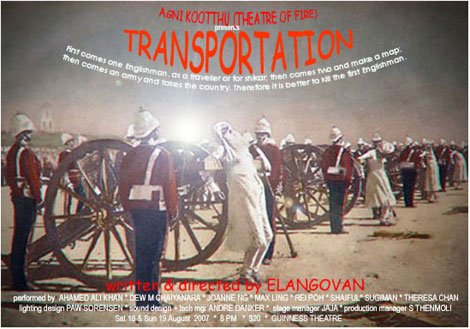
TRANSPORTATION
presented by AGNI KOOTTHU (THEATRE OF FIRE)
written & directed by ELANGOVAN
performed by AHAMED ALI KHAN, DEW M.CHAIYANARA, JOANNE NG, MAX LING, REI POH, SHAIFUL RISAN, SHARIFAH SOFIAH, SUDEEP BHUPAL SINGH, SUGIMAN RAHMAT & THERESA CHAN
lighting design: PAW SORENSEN s
ound design & technical manager: ANDRE DANKER
stage manager: JA JA
asst. stage & production manager: REZA
production manager: S THENMOLI
SAT 18 & SUN 19 AUG 2007
8 PM, $20
GUINNESS THEATRE, THE SUBSTATION
Tickets available at The Substation MDA
Advisory: Violent Content (16 years and above)
‘First comes one Englishman, as a traveller or for Shikar; then comes two and make a map; then comes an army and takes the country; therefore it is better to kill the first Englishman.’ – Pakhtun proverb
[February 24 1889. Society of Arts Lecture. Imperial Institue. London.
I, Richard Carnac Temple, Chief Commissioner of the Andamans unveiled a half-million Rupee vision to crush once and for all the mutinuous spirit of the Indian convicts.
Prisoners would no longer live in barracks. A brand new 698-cell Panopticon is now rising out of the mangrove swamps on a promontory called Atlanta Point, overlooking the main town of Port Blair.
From its Central Tower radiated seven 150-yard wings that rose to three levels. Each level is fitted with 52 cells, 13.5 feet by 7.5 feet.
Each cell is supplied with a 6 feet by 3 feet wooden slat bed and ventilated by a barred 3 feet by 1 feet grate.
This huge, practical reformatory would force every convict to bend rebellious nature to the yoke. I promise them a fate even more dreadful than the hangman’s noose.]
TRANSPORTATION explores the pain of the exilic journey – penal transportation – migration, experience of enslavement, forced removal for labour, oppression and exploitation, focusing on this as both an individual and as a collective experience. It captures the displacement and suffering, cultural denigration and crisis of identity that ensues from all forms of estrangement in the colonial period in the penal settlements.
It reconstructs the experiences of native criminals and political prisoners transported overseas to the penal settlements established by the British, from the late eighteenth to mid-twentieth centuries, in Southeast Asia, the Indian Ocean and the Andaman Islands. Thousands of Indian convicts were shipped to them, tattooed / branded on forehead, fettered in chains, put to work on infrastructural labour projects, flogged, and hanged.
The British photographed them in the nude to glean morphometric data to standardize ethnographic photography and force-fed them with new medicines in secret pharmaceutical trials.
They were at Bencoolen, Batavia (1787-1825), Penang, otherwise known as Prince of Wales Island (1790-1860), Mauritius (1815-1853), Malacca and Singapore (1825-1860), Burmese provinces of Arakan and Tenasserim (1828-1862) and the Andaman Islands (1858-1945). Many never returned home.
– S Thenmoli President Agni Kootthu (Theatre of Fire)